
How Long Does Concrete Hardener Take to Cure?
A structure stays reliable only when its foundation performs as intended. Concrete supports homes, offices, factories, and infrastructure, yet even this durable material can lose surface strength over time. Abrasion, chemicals, and moisture slowly weaken untreated slabs. To prevent this, builders often apply a concrete hardener after pouring. This treatment improves durability from within, extending floor life while reducing chipping, dusting, and surface breakdown.
How Long Does Concrete Hardener Take to Cure?
Concrete Hardener Curing Time Explained
A structure stays reliable only when its foundation performs as intended. Concrete supports homes, offices, factories, and infrastructure, yet even this durable material can lose surface strength over time. Abrasion, chemicals, and moisture slowly weaken untreated slabs. To prevent this, builders often apply a concrete hardener after pouring. This treatment improves durability from within, extending floor life while reducing chipping, dusting, and surface breakdown.
Concrete curing is not a fixed-duration process. Timing varies depending on mix design, site conditions, moisture levels, temperature, and application method. Asianbond provides clear, practical guidance based on real-world use—highlighting why curing time matters, how to avoid common mistakes, and what builders should expect under changing conditions.
What Is a Concrete Hardener?
A concrete hardener penetrates new or existing concrete and reacts with free lime and calcium hydroxide inside the slab. This reaction forms calcium silicate hydrate (C-S-H), the compound responsible for concrete’s structural strength. Over time, treated surfaces become denser, more abrasion-resistant, and better able to withstand daily wear.
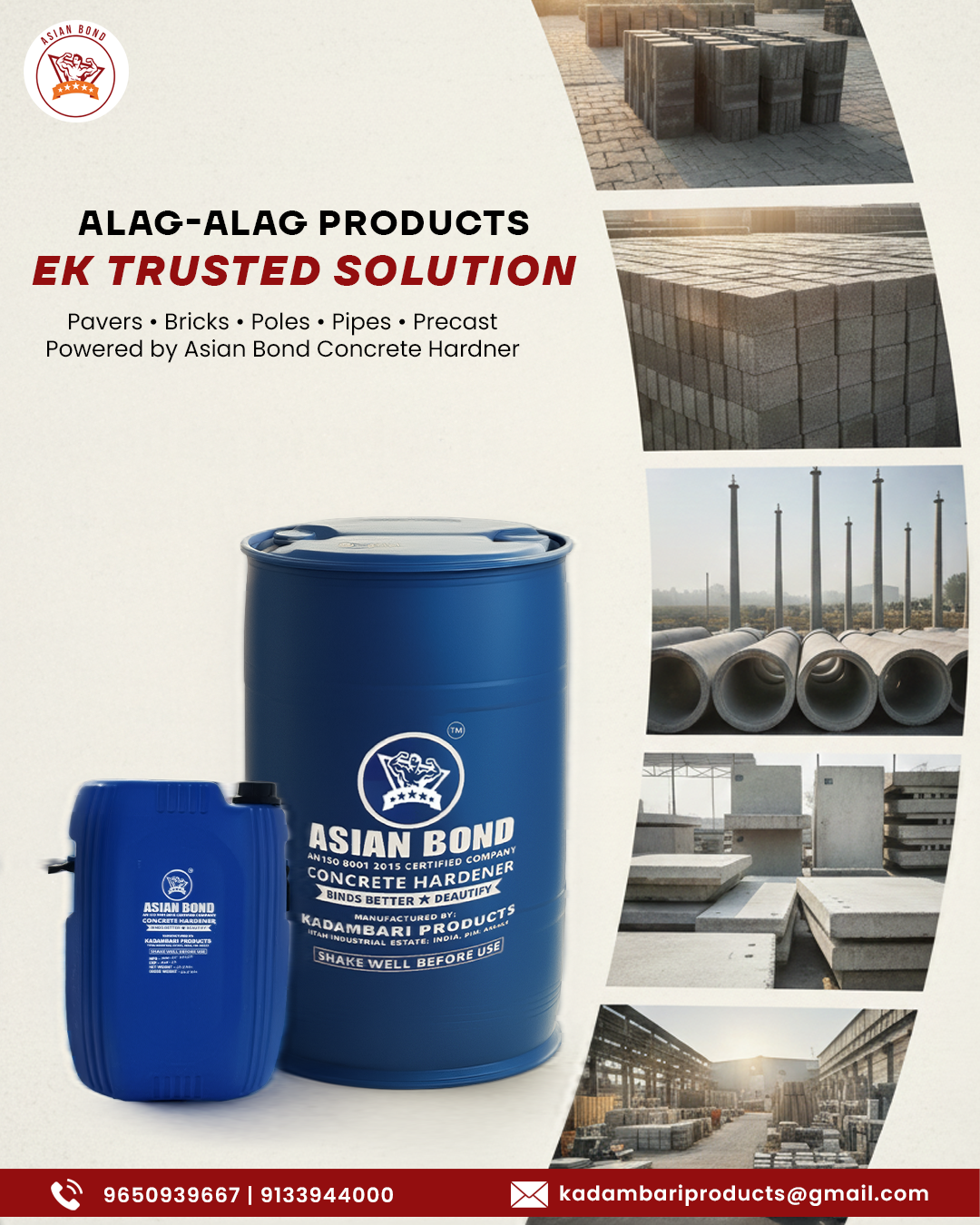
Different formulations serve different needs. Liquid hardeners may be used on brick surfaces, while chemical hardeners designed for slabs are preferred for industrial flooring. Asianbond develops application-specific formulations tailored for bricks, paver blocks, and heavy-duty floors, focusing exclusively on performance-driven additives.
Why Concrete Hardeners Matter
- Improves abrasion resistance where traffic and friction are constant
- Increases surface density and load-bearing strength
- Reduces dusting by locking loose particles in place
- Enhances surface sheen and simplifies cleaning
- Protects against moisture ingress and chemical attack
- Performs reliably across varied Indian climates
Choosing a trusted formulation such as Asianbond ensures consistent chemical performance in hot, humid, or variable regional conditions.
How Curing Works
After application, the hardener requires time to react internally. Hardness develops only once this chemical transformation completes. Some products set within hours, while others require several days depending on site conditions.
Curing time depends on:
- Type of hardener (sodium, lithium, or potassium silicate)
- Concrete age and surface porosity
- Ambient temperature and humidity
- Application method and coverage rate
- Substrate thickness and absorption capacity
Fresh concrete often cures faster because internal moisture supports the reaction. Older slabs lack this moisture, extending the curing window.
Application Process
Surface Cleaning
Remove dust, grease, oil, and contaminants before applying any hardener. Clean surfaces allow proper penetration and reaction.
Moisture Check
Slight surface dampness is ideal. Excess water slows curing, while completely dry concrete reduces penetration.
Application
Apply using a sprayer or roller in steady, even passes. Avoid pooling. Maintain consistent coverage and inspect for missed areas.
Curing Period
Allow at least 24–48 hours for the reaction to complete under normal conditions.
Washing and Sealing
Once cured, wash residues if required and apply a compatible sealer where additional protection is needed.
Following Asianbond’s application and coverage guidelines ensures predictable curing and long-term performance.
Typical Concrete Hardener Curing Times
- Fresh concrete: Initial curing within hours, full set in 24–36 hours
- Older concrete: Full curing may take up to 72 hours
- Heavy traffic areas: Wait at least 7 days before full use
Temperature control is critical. Cold conditions slow reactions, while excessive heat causes premature drying. Asianbond formulations are engineered to perform reliably across wide temperature ranges.
Applications and Curing Behavior
Paver Blocks
Hardeners improve resistance to wear and cracking, preserving appearance under constant foot traffic.
Bricks
Liquid hardeners speed initial strength gain, improving manufacturing efficiency.
Factory Floors
Chemical floor hardeners protect against oil, grease, and heavy machinery loads.
Commercial & Residential Floors
Treated surfaces resist dusting and abrasion while maintaining long-term appearance.
Factors That Influence Curing Time
- Ambient temperature and humidity
- Concrete age and porosity
- Thickness and density of the slab
- Product formulation and freshness
- Application thickness and uniformity
Lithium-silicate hardeners typically cure faster, while over-application can slow drying and cause uneven results.
Pricing and Bulk Purchasing
Concrete surface hardener pricing varies based on formulation and volume. Contractors purchasing in bulk through authorized suppliers often achieve lower per-unit costs while maintaining consistent quality across sites.
Why Builders Choose Asianbond
- Application-specific formulations
- Faster curing with deep penetration
- ISO- and BIS-aligned production standards
- Reduced maintenance over time
- Reliable nationwide supply chain
Maintenance After Curing
After full curing, maintain floors using mild cleaning solutions. Avoid harsh chemicals during early use and delay heavy traffic until the surface reaches full hardness.
Conclusion
Concrete hardener curing time typically ranges from one to three days, influenced by environmental and material conditions. When treated with a high-quality formulation such as Asianbond, curing becomes more predictable and performance improves long term. Proper timing, preparation, and patience ensure durable, dust-free, and resilient concrete surfaces.