
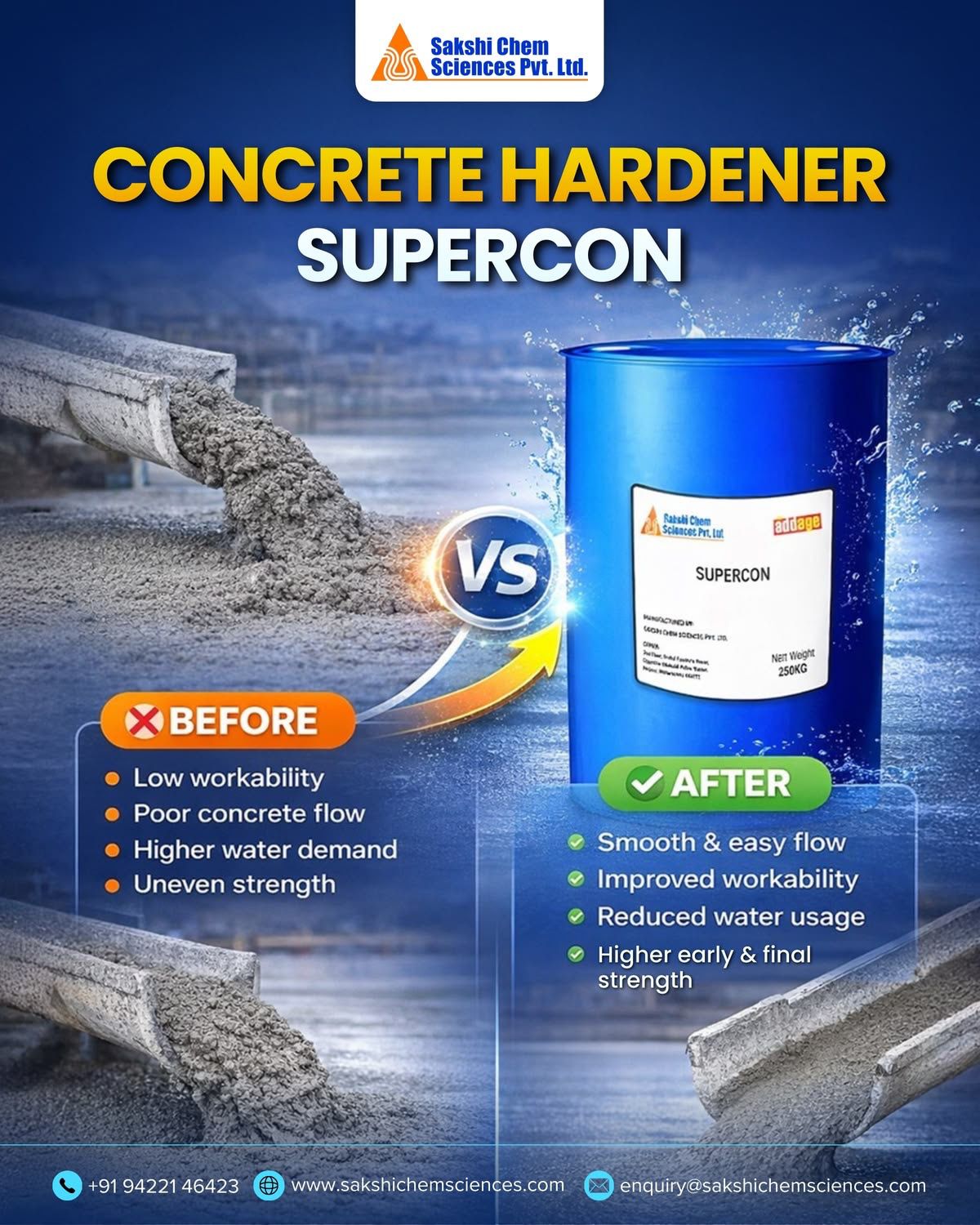
Concrete Hardener versus Concrete Sealer – Understanding the Contrast
Durability defines the success of any structure. Whether it is factory flooring, entry paths, warehouses, paver units, or shopping complexes, protecting the concrete surface is essential. Two common solutions are concrete hardeners and concrete sealers. While they may appear similar, their functions differ significantly in performance and long-term impact.
Concrete Hardener versus Concrete Sealer – Understanding the Contrast
Durability defines the success of any structure. Whether it is factory flooring, entry paths, warehouses, paver units, or shopping complexes, protecting the concrete surface is essential. Two common solutions are concrete hardeners and concrete sealers. While they may appear similar, their functions differ significantly in performance and long-term impact.
If you are evaluating concrete hardeners in India, understanding how each system works helps you make a technically sound decision rather than relying on labels alone.
Understanding Concrete Hardener
A concrete hardener is a chemical compound (powder or liquid) that penetrates into the concrete surface and reacts with free lime and other minerals. This reaction forms insoluble crystalline structures within the pores of the slab.
The result:
- Increased surface density
- Higher compressive strength
- Reduced dust formation
- Improved abrasion resistance
Because the transformation occurs internally, the hardener becomes part of the concrete structure rather than sitting on top.
Common Applications of Concrete Hardener
- Industrial warehouses
- Manufacturing plants
- Parking lots
- Commercial floors
- Paver block production units
In paver manufacturing, early-stage hardener integration improves edge strength and reduces cracking. Liquid hardeners are also used in brick production to enhance durability and minimize structural splits.
For large-scale projects, buying concrete hardener in bulk can improve cost efficiency and maintain supply consistency.
Concrete Sealer Meaning
A concrete sealer is a protective coating applied to the surface of cured concrete. Unlike a hardener, it does not chemically transform the internal structure. Instead, it forms a barrier that prevents moisture, stains, and environmental damage.
Common Uses of Concrete Sealers
- Decorative concrete
- Driveways
- Residential patios
- Stamped concrete
- Exterior walkways
Sealers protect against water penetration and staining but do not significantly increase compressive strength or structural density.
Concrete Hardener vs Concrete Sealer – Key Differences
1. Purpose
Concrete Hardener: Chemically increases internal density and strength.
Concrete Sealer: Provides surface-level protection against moisture and stains.
If structural durability is the priority, a high-performance concrete hardener is preferable. If aesthetic protection or moisture resistance is the goal, a sealer may be sufficient.
2. Application Timing
Hardener: Applied during finishing or after curing depending on type.
Sealer: Applied only after complete curing and surface drying.
In paver manufacturing, hardeners are often incorporated early to improve long-term structural strength.
3. Industrial Suitability
In heavy industrial environments, sealers wear down quickly under forklift traffic and constant load. Floor hardener chemicals provide deeper protection suitable for:
- Factories
- Logistics hubs
- Heavy traffic zones
Large-scale infrastructure projects typically consult concrete admixture manufacturers in India when selecting hardening systems for industrial-grade durability.
4. Longevity
Concrete Hardener: Long-lasting, integrates permanently with the slab.
Concrete Sealer: Requires reapplication every few years depending on traffic and weather exposure.
Why Concrete Hardener Matters in Industrial Settings
Factory flooring experiences continuous mechanical stress, chemical exposure, and heavy load movement. A properly selected floor hardener chemical delivers:
- Improved abrasion resistance
- Reduced dust formation
- Increased compressive strength
- Long-term cost savings
Contractors often prioritize sourcing from reliable local concrete hardener suppliers to ensure timely delivery and consistent quality.
Concrete Hardener for Paver Blocks and Bricks
Paver blocks and bricks frequently develop cracks if untreated. A concrete hardener:
- Improves surface density
- Enhances load-bearing capacity
- Reduces water absorption
- Extends outdoor durability
Before purchasing, many companies compare concrete surface hardener price, penetration depth, and supplier reliability.
Selecting the Right Concrete Hardener
Choosing the best concrete hardener in India depends on:
- Project type (industrial, commercial, residential)
- Traffic load
- Environmental exposure
- Budget constraints
- Required durability level
Comparing suppliers and reviewing technical documentation ensures performance aligns with project demands.
When to Use a Concrete Sealer
A concrete sealer may be sufficient for:
- Decorative flooring
- Residential patios
- Driveways
- Low-load areas
For heavy-duty applications, a chemical hardener is the more appropriate solution.
Conclusion
Concrete hardeners and sealers serve different technical purposes. Hardeners enhance internal strength and long-term durability, while sealers provide surface-level protection against moisture and stains.
The correct choice depends on structural requirements, exposure conditions, and performance expectations. Understanding the distinction ensures floors remain durable, cost-efficient, and fit for purpose over time.