
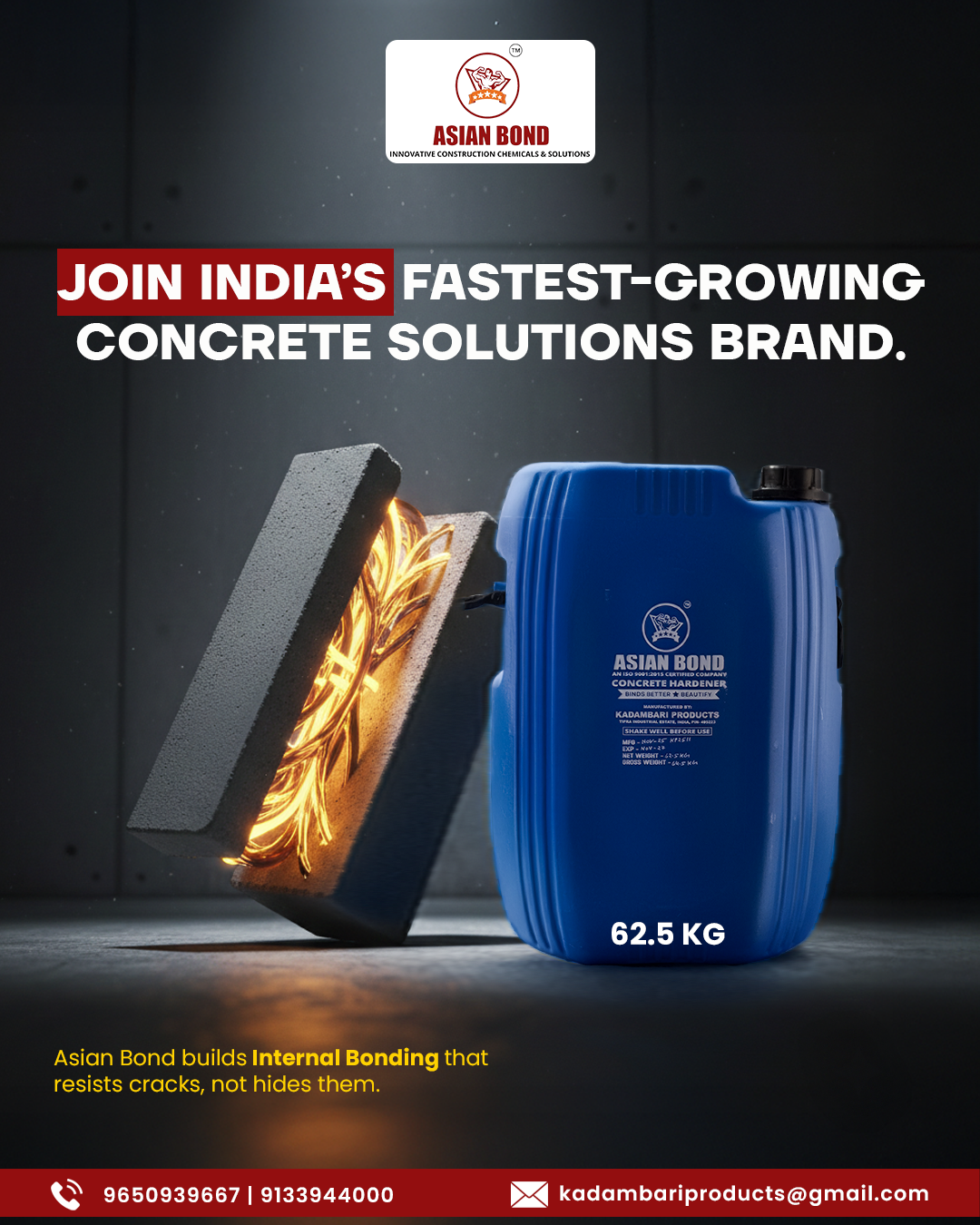
Concrete Hardener Quality Testing & Standards
Concrete hardeners significantly influence how long floors and slabs perform under stress. Proper quality testing ensures builders, contractors, and developers can rely on measurable performance rather than marketing claims.
Concrete Hardener Quality Testing & Standards
Concrete hardeners significantly influence how long floors and slabs perform under stress. Proper quality testing ensures builders, contractors, and developers can rely on measurable performance rather than marketing claims.
What Is a Concrete Hardener?
A concrete hardener penetrates the pores of cured concrete and reacts chemically with free calcium hydroxide. This reaction forms additional dense compounds within the slab, improving surface strength, abrasion resistance, and long-term durability.
Products such as asianbond are formulated for Indian climate conditions and comply with recognized ISO-based manufacturing practices. Deep penetration and consistent chemical bonding are essential to reliable performance.
Why Quality Testing Matters
Concrete hardeners must undergo rigorous laboratory and field testing before use in demanding environments. Testing validates:
- Abrasion resistance
- Compressive strength improvement
- Penetration depth
- Chemical resistance
- Consistency across production batches
Without structured testing, premature failure can result in expensive repairs and loss of client trust. Established manufacturers such as asianbond conduct repeated batch-level evaluations to ensure uniform performance.
Industry Standards for Concrete Hardeners
Recognized standards define acceptable performance thresholds for concrete treatments:
- ISO 9001 – Quality management systems
- ASTM C779 – Abrasion resistance testing
- ASTM C131 – Resistance to degradation
- BIS Standards (India) – Safety and durability compliance
- IS 456 – Durability of reinforced concrete
Floor hardeners intended for heavy factory traffic must comply with these benchmarks. Asianbond aligns production and testing procedures with these standards to ensure suitability for industrial use.
Types of Concrete Hardeners
Liquid Hardeners
Penetrate deeply into cured concrete, masonry, and brickwork. Suitable for both new and existing surfaces.
Dry Shake Hardeners
Applied to freshly poured concrete during finishing. Common in industrial flooring systems.
High-performance formulations may achieve penetration depths up to 8mm, exceeding superficial surface treatments.
Testing Methods Explained
Abrasion Resistance Testing
Under ASTM C779 procedures, treated surfaces are subjected to controlled wear cycles. Premium hardeners demonstrate minimal mass loss under repeated abrasion.
Compressive Strength Testing
Hardened concrete specimens are tested to evaluate strength gain after application. Quality formulations may increase compressive strength by up to 30–40%.
Impact and Chemical Resistance
Floors are exposed to mechanical shock and chemical contact. Industrial-grade hardeners must withstand oils, acids, and heavy equipment stress without surface degradation.
Application in Paver Blocks and Masonry
Concrete hardener improves edge strength in paver blocks, enhances color retention, and reduces cracking during handling. Liquid formulations also seal brick pores, minimizing moisture ingress.
Manufacturers such as asianbond supply bulk quantities suitable for production lines, ensuring uniform treatment across batches.
Factory & Industrial Applications
Industrial floors require hardeners that withstand:
- Heavy machinery traffic
- Forklift movement
- Chemical spills
- Continuous abrasion
High-performance floor hardeners may extend floor service life beyond 30 years when properly applied and maintained.
Sourcing Reliable Suppliers
When selecting a concrete hardener supplier, evaluate:
- Compliance certifications
- Customer performance history
- Technical support availability
- Consistent supply chain capability
- Transparent concrete surface hardener pricing
Bulk procurement ensures consistent material performance across large projects while reducing per-unit cost.
Pricing Considerations
Concrete hardener pricing typically ranges from ₹50 to ₹150 per liter, depending on formulation and volume. Bulk purchases reduce overall project costs while maintaining performance consistency.
Long-term value should be evaluated based on durability gains rather than initial purchase price alone.
Installation Best Practices
- Clean and prepare the surface thoroughly
- Apply on moist, properly cured concrete
- Ensure even distribution
- Follow recommended coverage rates (approx. 200–400 sq ft per liter)
- Allow proper curing time
Conduct small test patches before full-scale application to confirm compatibility and penetration behavior.
Bulk Purchasing Guidance
Projects exceeding 10,000 square feet benefit from bulk procurement, often reducing cost by 20–30%. Reliable manufacturers coordinate packaging and delivery to maintain steady production flow.
Conclusion
Concrete hardener performance must be validated through recognized testing standards. Abrasion resistance, compressive strength gain, chemical durability, and batch consistency determine long-term success.
Selecting a certified manufacturer with documented compliance ensures dependable results across industrial, commercial, and paving applications. Quality testing is not optional—it is the foundation of durable concrete performance.