
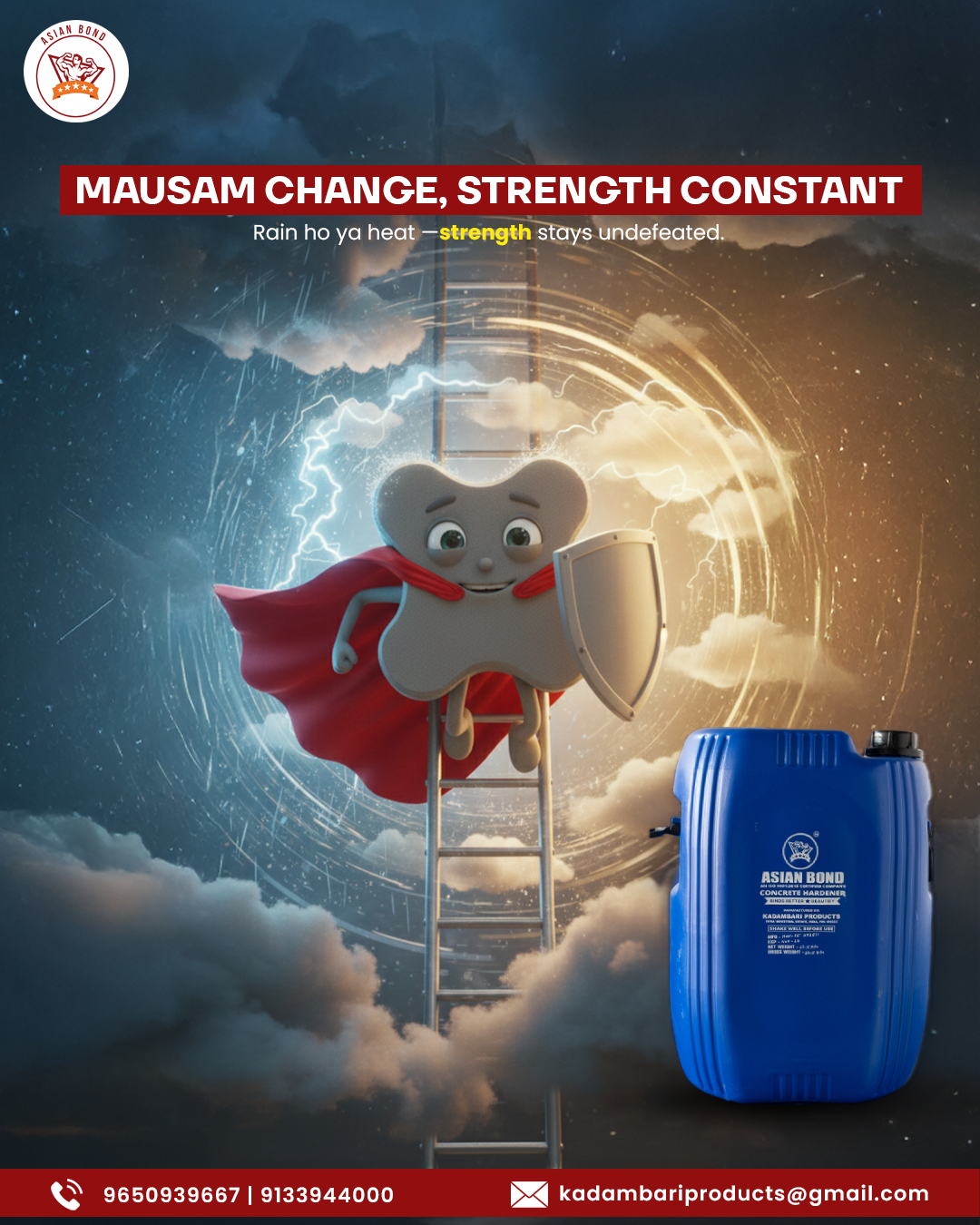
Concrete Hardener for Cold Climate Construction
Cold weather changes how concrete behaves. When temperatures drop, hydration slows, early strength suffers, and surfaces become vulnerable to cracking, dusting, and long-term failure. In such conditions, standard concrete mixes often fall short.
Concrete Hardener for Cold Climate Construction
Cold weather changes how concrete behaves. When temperatures drop, hydration slows, early strength suffers, and surfaces become vulnerable to cracking, dusting, and long-term failure. In such conditions, standard concrete mixes often fall short. That is why construction in cold climates depends on specialized concrete hardeners engineered to perform reliably under freezing and near-freezing temperatures.
AsianBond has emerged as a trusted solution for cold-climate construction across India. Designed to perform even when temperatures fall, its concrete hardener formulations continue to build strength where ordinary mixes struggle. Instead of weakening under frost, treated concrete maintains durability through intelligent chemical design focused on harsh seasonal conditions.
Why Cold Weather Weakens Ordinary Concrete
When ambient temperatures drop below 10°C, the cement hydration process slows dramatically. As a result, early strength development is delayed, leaving concrete vulnerable during its most critical phase. In extreme cases, strength loss can reach up to 40–50% if curing conditions are not controlled.
- Freeze–thaw cycles cause internal expansion and cracking
- Moisture trapped in pores freezes and widens micro-cracks
- De-icing salts penetrate porous concrete and accelerate damage
- Dusting occurs when surfaces fail to densify properly
Concrete hardeners designed for cold climates counter these issues by densifying the surface, reducing porosity, and accelerating beneficial chemical reactions even at lower temperatures.
How AsianBond Concrete Hardener Performs in Cold Conditions
AsianBond’s chemical hardeners are formulated with advanced silicates that react with free lime inside concrete to form additional calcium silicate hydrate (C-S-H). This compound is responsible for concrete’s strength. Unlike conventional systems, AsianBond’s formulation continues to react efficiently even in colder environments.
By penetrating the concrete surface and locking loose minerals together, the hardener creates a dense, frost-resistant layer. This internal strengthening protects against moisture ingress, surface abrasion, and repeated freeze–thaw cycles.
Key Benefits in Cold Climate Construction
- Improved early strength despite low temperatures
- Reduced water absorption and frost damage
- Resistance to de-icing salts and wet conditions
- Lower dusting and surface wear
- Faster setting compared to untreated concrete
These advantages make AsianBond concrete hardener especially effective in regions prone to freezing conditions, such as Himachal Pradesh, Uttarakhand, Jammu & Kashmir, and other high-altitude or winter-affected zones.
Typical Applications in Cold Regions
- Industrial floors and warehouses
- Outdoor parking areas and driveways
- Bridges, sidewalks, and curbs
- Paver block production and installation
- Brick manufacturing and masonry work
- Factory floors exposed to abrasion and salts
Liquid concrete hardener used on bricks and paver blocks helps prevent frost damage, improves compressive strength, and ensures long-term durability in outdoor conditions.
Types of AsianBond Hardeners for Cold Weather
AsianBond offers multiple hardener variants, each engineered for specific cold-climate challenges:
- Silicate-based liquid hardeners – penetrate deeply to densify surfaces and reduce dusting
- Paver block hardeners – improve unit bonding and resist freeze-induced cracking
- Liquid hardeners for bricks – maintain production speed and strength even in cold curing conditions
- Industrial floor hardeners – withstand abrasion, chemicals, and thermal stress
Application Guidelines for Cold Weather
Applying a chemical hardener in cold conditions requires precision:
- Clean the surface thoroughly to remove dust, oil, and coatings
- Apply during daylight hours when temperatures are relatively stable
- Use misting, rolling, or spraying for uniform coverage
- Allow sufficient dwell time for penetration and reaction
- Maintain stable moisture and temperature during curing
- Finish with polishing or sealing if required
Timing is critical in cold climates. Applying the hardener when ambient temperatures are slightly higher helps ensure optimal absorption and reaction.
Performance on Paver Blocks in Winter
Paver blocks are particularly vulnerable to freeze–thaw damage. Water entering untreated blocks expands when frozen, leading to cracking and surface spalling. AsianBond concrete hardener seals internal pores, preventing moisture ingress and strengthening the block structure.
Treated pavers show improved load resistance, reduced cracking, and a smoother, more durable surface that withstands repeated winter cycles without degradation.
Cost Efficiency and Bulk Supply
While high-quality concrete surface hardeners may cost more initially, they deliver significantly lower lifecycle costs. Reduced repairs, longer service life, and minimal maintenance offset the upfront investment.
AsianBond offers clear pricing and bulk purchase options, making it cost-effective for large cold-climate projects. Its nationwide supplier network ensures timely delivery even to remote job sites.
Sustainability and Long-Term Value
Concrete that lasts longer requires fewer repairs and replacements, reducing material waste and environmental impact. AsianBond’s formulations support sustainable construction by extending surface life while maintaining appearance and performance.
Treated surfaces demand less maintenance, perform consistently under heavy traffic, and retain strength across seasons—making them ideal for cold-climate infrastructure.
Final Thoughts
Cold climates demand stronger concrete solutions. AsianBond concrete hardeners are engineered to perform where freezing temperatures, moisture, and abrasion challenge conventional materials. From paver blocks to industrial floors, these deep-acting formulations deliver durability that holds firm through winter and beyond.
When reliability matters most and weather cannot be controlled, choosing the right concrete hardener makes all the difference. AsianBond’s cold-climate solutions are built not just to survive winter—but to outlast it.